|
|
|
 A Company of Union of Scientists in Bulgaria 
|
|
|
Volume 1, Issue 1 THE USE OF THERMOLUMINESCENT DETECTORS FOR RADIATION MONITORING ON TERRITORIES OF ATOMIC POWER PLANTS V.S. Kortov, I.I. Milman, S.V. Nikiforov, E.A. Gorelova The Ural State Technical University, 19 Mira Street, 620002 Ekaterinburg, Russia Recived 20.05.2000; Cited 28.09.2000
Abstract Characteristics and operating features of TLD-500K thermoluminescent detectors of ionizing radiation are described. These detectors are used in environmental monitoring and personal dosimetric applications. The width of glow curves was found to correlate with the fading value. If TLD-500K detectors operate at temperatures above +30 ° C, it is recommended that the detectors have similar glow curves parameters. To reduce fading, the width of the dosimetric peak should be a maximum. International Intercomparison of environmental dosimeters confirmed that the said detectors meet the requirements of the American National Standards Institute with respect to the environmental thermoluminescent dosimetry. Key words: thermoluminrscent dosimetry, radiation monitoring, thermoluminescent detectors
Introduction The effect of natural and artificial sources of ionizing radiation on human health has been studied on an ever increasing scale. In this connection, it is necessary to develop efficient means of environmental radiation monitoring. One of the most significant challenges of radiation monitoring consists in estimating the dose loads on sites of atomic power plants (APP's) and in the vicinity of technological nuclear installations.
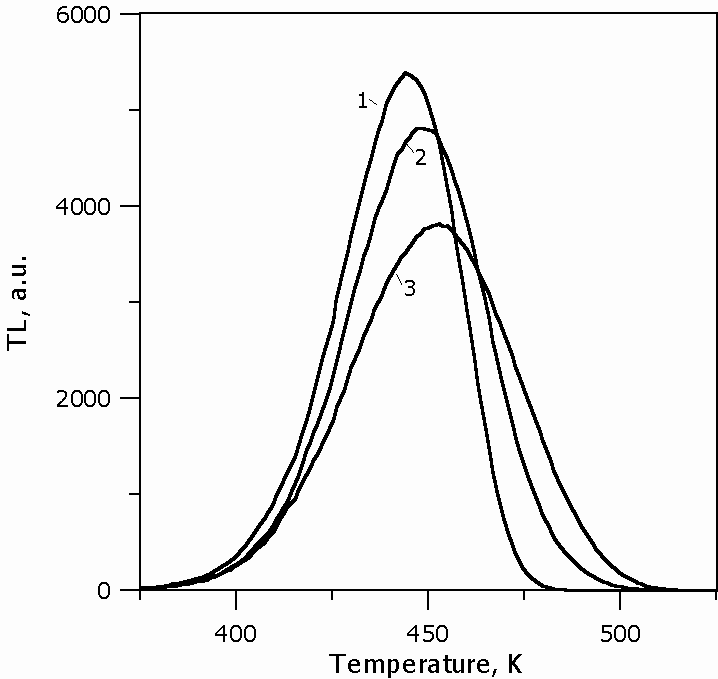
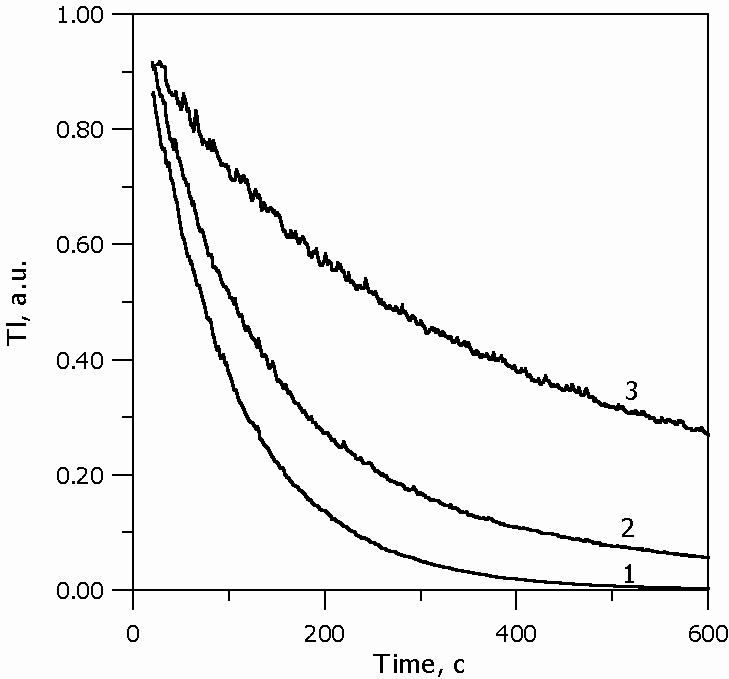
All these requirements are satisfied by thermoluminescent ionizing radiation detectors type TLD-500K based on nonstoichiometric anion-defective single crystals of corundum. These detectors have been developed at the Ural State Technical University (Ekaterinburg, Russia) [3] and are used currently in Russia and other countries for environmental monitoring and personal dosimetry. This paper deals with an experimental study into possible correlations between fading of the detectors and parameters of glow curves. A method for prediction of fading from the analysis of thermoluminescence kinetics parameters is substantiated. 1. Subject of Study The detectors represent pellets 5 mm in diameter and 1 mm thick. They were grown by Stepanov's method in reducing conditions. The TLD-500K detectors had the following characteristics: Gamma-radiation sensitivity, quanta/Gy (1-2)× 1011 Sensitivity variation of detectors from a single batch, % 5 Yearly fading, % 5 Permanent sensitivity dose interval, Gy 10- 6 to 1 Registered dose interval, Gy 10- 6 to 10 Natural background dose equivalent, Gy 5× 10- 7, maximum Reading variation of a single detector, % 5 Re-usability, times 500 Luminescence effect of light at 300 lx in 1 minute, % 3, maximum Energy dependence of the detector sensitivity at the energy of 37 keV relative 1250 keV 3.0, maximum Glow curves of the detectors exhibit an isolated (dosimetric) peak in the interval from 400 to 500 K. A small half-width and an optimal temperature location of the peak ensure good conservation of the dosimetric information (the yearly fading does not exceed 3%) and make it possible to distinguish easily between the luminescence response and thermal radiation of the heater. These features in combination with a high sensitivity and a low natural background of the detectors provide the lower limit of registered doses near 1 m Gy. At high doses, the detectors give a linear response up to 10 Gy. Thus, the dynamic sensitivity interval of the detectors is seven orders of magnitude. Consequently, these detectors are applicable both for environmental radiation monitoring of small doses and registration of emergency doses. A significant advantage of the detectors is that they can be used repeatedly for registration of small doses without additional thermal treatment. Thanks to this feature, the detectors are simpler to operate and their maintenance cost is reduced. A high mechanical strength, chemical and radiation resistance are inherent in single crystals of aluminum oxide. These properties prolong the service life of the detectors. The TLD-500K detectors are sensitive to light. In most cases, this drawback can be overcome by placing the detectors in special lightproof cassettes. The material of the TLD-500K detectors (the effective atomic number is 10.2) is not equivalent to biological tissues. Therefore, the detector sensitivity depends on the photon irradiation energy. The cassettes should be outfitted with correcting filters to eliminate the energy dependence of sensitivity. One of the main requirements imposed on a batch of detectors used for environmental radiation monitoring is their uniform sensitivity, which should be constant to within 5%. To make up a batch of detectors with the preset sensitivity variation, they undergo tests, which include exposure of detectors to a known dose, registration of glow curves, and determination of the TL output from the glow curves. The TL output characterizes sensitivity of an individual detector. In this case, it is impossible to evaluate fading of the detectors under different environmental conditions. However, operating experience of TLD-500K detectors used for radiation monitoring at APP's in Russian Federation suggests that their sensitivity can change with the environmental temperature owing to different fading of the detectors. 2. Results and Discussion A test dose of Sr90/Y90 b -radiation (0.05 Gy) was used to excite luminescence in TLD-500K detectors. Measurements showed that some detectors in a test batch of 30 detectors gave glow curves with largely different shapes. At the heating rate of 2 K/s, the temperature position of the dosimetric peak, Tm, varied between 445 and 455 K, while the half-height width of the dosimetric peak was w = 37-58 K. The temperature position and the half-height width of the peak were measured to within ± 2 K and ± 1 K respectively. Detectors, whose glow curves differed by Tm and w values, were divided into three groups. Typical glow curves of the detectors from the first (Tm = 445 K, w = 38 K), second (Tm = 449 K, w = 45 K), and third (Tm = 455 K, w = 53 K) groups are given in Fig. 1. These glow curves were registered during linear heating at the rate of 2 K/s. It is known that fading of detectors correlates with the luminescence decay rate under isothermal conditions [2]. The analysis of the isothermal decay curves registered at temperatures from 403 to 473 K showed that the decay rate was largely different in detectors from the three groups. Specifically, the isothermal decay rate decelerated with increasing width of the glow peak. The isothermal luminescence decay curves registered at 418 K are given in Fig. 2.
Fig. 1. Typical glow curves for the TLD-500K detectors from the first (1), second (2), and third (3) groups
Fig. 2. Typical isothermal luminescence decay curves at 418 K (for the numbers at the curves refer to Fig. 1) To establish correlations between fading of the detectors and parameters of their glow curves, fading was examined as a function of the dosimetric peak width. Measurements were made at elevated temperatures from 130 to 180 ° C so as to reduce the test duration. The detectors were exposed to a test dose of b -radiation (0.05 Gy). Then the TL output was determined (heating rate of 12 K/s). Subsequently the detectors were again exposed to the same test dose and were kept for the assigned time at a constant temperature. Finally, the TL output was measured during linear heating. Fading was calculated by the formula
where F denotes fading (%); S1 and S2 stand for the TL output of the detectors before and after storage respectively. The correlation between fading and the peak width was evaluated from the formula
where r is the correlation; w i denotes the full width of the glow curve of the i-th detector in the batch; Fi is the corresponding fading. Our findings show that high-temperature fading correlates with the width of the dosimetric peak (correlation is within 0.85 to 0.95). Figure 3 shows fading of the detectors in 1 minute vs. the glow curve width at 150 ° C. It is seen that fading tends to decrease with growing width of the dosimetric peak (correlation equals 0.90).
Fig. 3. Fading of the detectors vs. the glow curve width in 1 minute at 150 ° C One may think that the difference in the properties of the detectors, which was revealed by the last two tests, is due to different content of defects. To verify this hypothesis, the experimental glow curves (Fig. 1) and the isothermal luminescence decay curves (Fig. 2) were compared with their counterparts calculated in terms of the model concepts of a uniform energy distribution of trapping levels in the interval E = E2 - E1 [4]. Since the width of the distribution E characterizes the degree of defectness of the material studied, it should increase as the glow curve widens. Glow curves were modeled using an equation, which describes the TL process in terms of the model chosen. This equation was modified allowing for specific features of TL in TLD-500K detectors [5]:
The isothermal decay curves were modeled using an equation, which corresponded to the model chosen:
In these formulas, n0 is the total number of captured charge carriers; k is the Boltzmann constant; T is the absolute temperature; is the linear heating rate; t is the time. The activation energy W = 0.97 eV and the constant C = 1011, which are characteristic of the detector material, were determined elsewhere [5]. The activation energies E1 and E2 and the frequency factor S were fitted to provide the best agreement between experimental and theoretical results. Modeled kinetic parameters of TL in the detectors comprising the three groups are summarized in Table 1. Table 1. Kinetic parameters of TL in the detectors
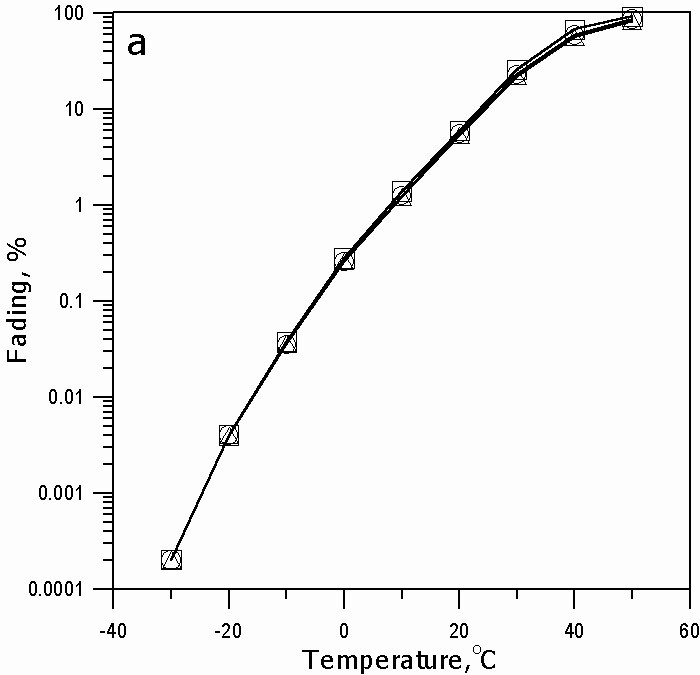
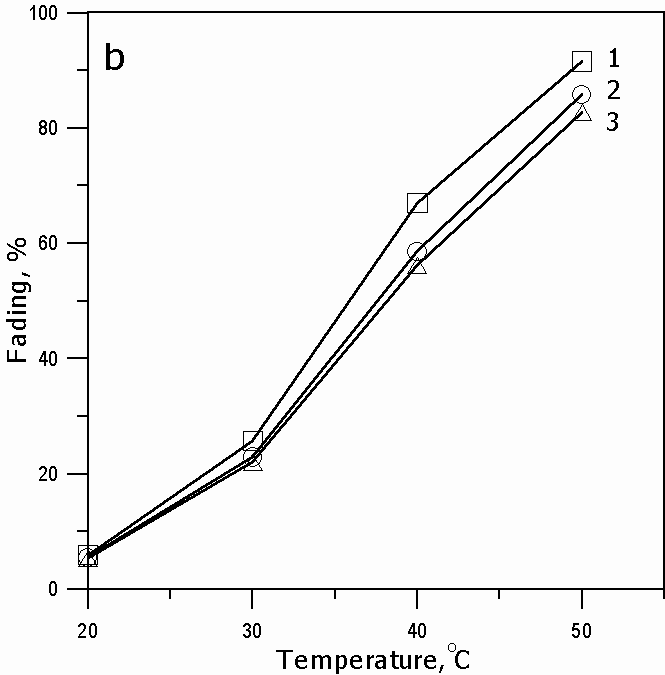
At these parameter values the experimental curves are approximated with the accuracy of 5% or better. The reliability of the calculated kinetic parameters was checked by comparing the TL outputs determined by integration of the equation (3) and those measured in the experiments. The difference did not exceed 20%. Our findings show that the detectors have different width of energy levels: 0.01 eV and 0.14 eV in detectors with narrow and wide peaks respectively. Values of the kinetic parameters for the three groups of detectors with different types of glow curves (Table 1) were used to predict the relative change in sensitivity of irradiated detectors under real conditions of radiation monitoring of territories in winter and summer. The sensitivity loss was calculated by the formula (4). Figure 4 shows calculated yearly fading in the groups of detectors when the ambient temperature varied between - 30 and +50 ° C. It is seen that at temperatures from - 30 to +30 ° C the yearly fading is nearly the same for detectors with different width of glow curves. At +22 ° C it equals 6-8%, which roughly coincides with the experimental value (5%) [3]. Detectors with different width of glow curves have different fading values when the storage temperature exceeds +30 ° C (Fig. 4b). Detectors, which provide narrow peaks, are characterized by larger fading. Thus, the fading prediction results suggest that if the TLD-500K detectors operate at temperatures above +30 ° C, which are specified in the normative documents [6], it is good practice to use a batch of detectors, which are characterized not only by a uniform sensitivity but also by the same type of glow curves. Detectors providing a widest dosimetric peak are preferable. The TLD-500K detectors were submitted to the 11th International Intercomparison of environmental dosimeters, which were organized in 1996 by the Environmental Measurements Laboratory at the US Department of Energy. The goal of the tests was to evaluate efficiency of dosimeters in measuring environmental radiation doses. Part of the dosimeters were placed outdoors and were kept for three months on a site not far from New York. They were fixed 1 meter above the ground using special plastic ropes. Temperature varied in the range from 13 to 31 ° C.
Fig. 4. Predicted fading of the detectors in 1-year storage at various temperatures (a) and fading at temperatures from +20 to +50 ° C (b). For the numbers at the curves refer to Fig. 1 The other dosimeters were exposed to radiation from a Cs-137 laboratory source. In addition, sensitivity of the environmental dosimeters to low-energy photons was tested. An Am-241 source was used for this purpose (photon energy of 60 keV). The air kerma served as the physical quantity characterizing irradiation in the field and laboratory conditions. Reference doses were measured in special ionization chambers and were unknown to the test participants. Irradiated dosimeters were returned to the participants for measurements. Readings of the TLD-500K detectors in DTU-2 cassettes [7] are given in Table 2. Table 2. Results of tests of the TLD-500K detectors in DTU-2 cassettes
The test results show that the TLD-500K detectors meet the criteria of the standard for environmental luminescent dosimetry (ANSI-N545) developed by the American National Standards Institute [8]. In accordance with this standard, the relative error of field and laboratory measurements should not exceed 30% and 10% respectively. The said standard also requires that sensitivity of dosimeters to photons whose energy is less than 80 keV should not be more than twice as high as sensitivity to the calibration source (Cs-137). The data of Table 2 show that the TLD-500K detectors meet this requirement too. Conclusion High sensitivity, small fading, and resistance to climatic factors of the TLD-500K detectors based on corundum single crystals make them promising for radiation monitoring on sites of atomic power plants. The International Intercomparison of environmental dosimeters showed that the detectors meet the requirements by the American National Standards Institute with respect to environmental thermoluminescent dosimetry. If the detectors are used for environmental monitoring at high temperatures, it is recommended to choose a batch of detectors, which are characterized not only by uniform sensitivity, but also by a similar shape of glow curves. Detectors providing the widest dosimetric peak of thermoluminescence are preferable. References 1. Applied Thermoluminescence Dosimetry. Ed. By M. Oberhofer and A. Scharmann, Adam Hilger, Bristol, 414 p., 1981 2. McKeever S.W.S.: Thermoluminescence of Solids, Cambridge University Press, Cambridge, 376 p., 1985 3. Akselrod M.S., Kortov V.S., Kravetsky D.J. and Gotlib V.I.: Radiat. Prot. Dosim., 1990, 32(1), 15-20 4. Hornyak W.F. and Chen R.: Journal of Luminescence, 1989, 44, 73-81 5. Kortov V.S., Milman I.I., Kirpa V.I. and Lesz J.: Radiat. Prot. Dosim., 1996, 65(1-4), 255-258 6.International Organization for Standartization. Personal and Environmental Thermoluminescence Dosimeters. ISO/TC85/SC2/WG 724E (1974). 7. Akselrod M.S., Guryashin A.P., Kortov V.S., Cherlov G.B., Bitshev V.R., Gotlib V.I., Fominych V.I., Fedina S.A. and Safonov I.S.: TL Dosimeter DTU-2 of Individual Dose Equivalent, International Symp. Luminescent Detectors and Transformers of Ionizing Radiation (LUMDETR’91), Riga, Report G3, 1991 8. American National Standard Institute. Perfomance, Testing and Procedural Specification for Thermoluminescence Dosimetry (Environmental Application). ANSI (New York) ANSI Report N545 (1975).
|
|









 , (1)
, (1)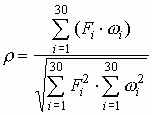 , (2)
, (2)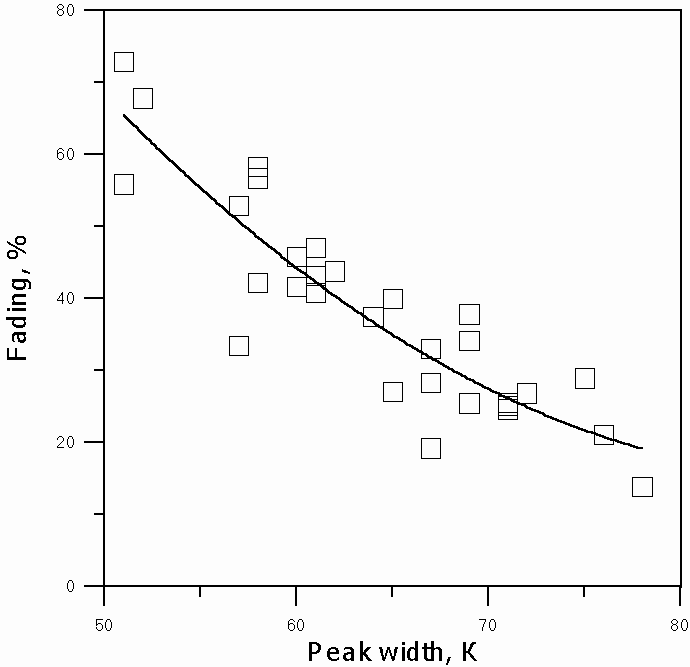
 . (3)
. (3) . (4)
. (4)